
Mirror, Mirror
The Age of Digital Twins, Simulated Creativity & Synthetic Talent

The Fashion Industry Isn’t Waiting for Better AI. It’s waiting for us to build the infrastructure to curate it.
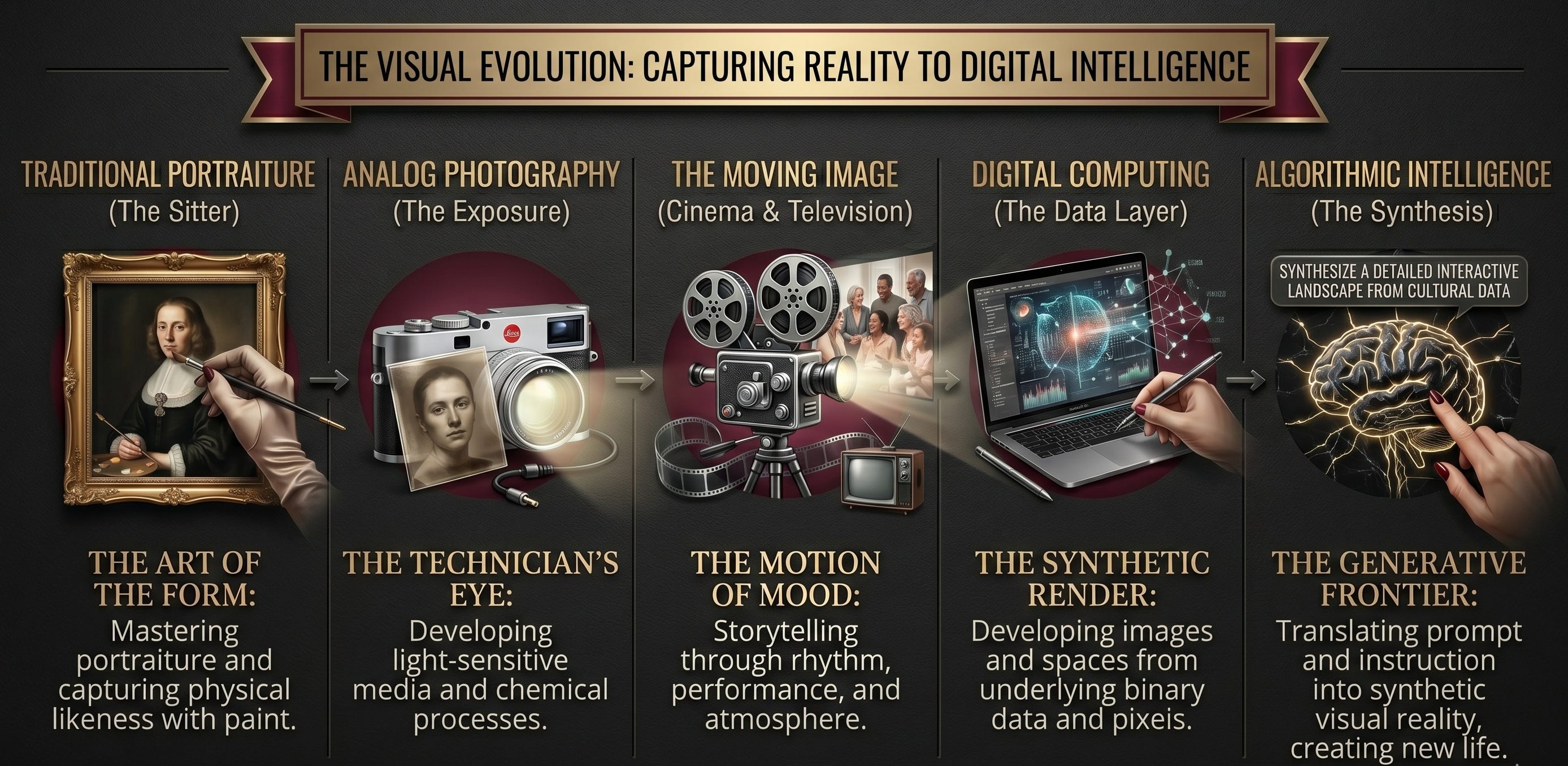
Every major fashion brand is experimenting with AI imagery. Almost none of them have set up how to keep human curators in the loop, manage assets, or implement a governance framework to survive what comes next.
Here’s why that gap is the most valuable real estate in the industry and what we’re doing about it at Visage.
In the mid-1990s, Nick Knight declared that photography was dead. Not as an eulogy — as a provocation. His argument: once you can transmit an image globally in an instant, or render a still into three dimensions, you’ve moved outside the medium’s original parameters entirely. The rules have changed. The medium hasn’t caught up.
We’re living through that exact moment again. Only this time, it’s not photography that’s dead. It’s the image that is produced with simulated creativity, with no humans involved (synthetic talent), and has unmanaged assets, identity and data that are ungoverned (no consent or compliance/safety).
The fashion industry generates billions of images a year. Those images carry talent likenesses, brand DNA, styling decisions, creative direction, and commercial intent. Until now, rights management was complex but bounded: a contract, a usage window, a territory.
What happens when a single asset becomes a bunch of 1s and 0s that can be scraped by a generative model, cloned, remixed, and redistributed in seconds, without any human curation, the talent’s consent, the brand’s knowledge, and without a single clause in any existing agreement that applies, because it has no precedent and can’t be litigated yet?
That’s not a hypothetical. That’s Today.
“Visage is not replacing the fashion production ecosystem; it is building the infrastructure layer that allows that ecosystem to evolve into the AI era. Where the talent seizes the means of production.”
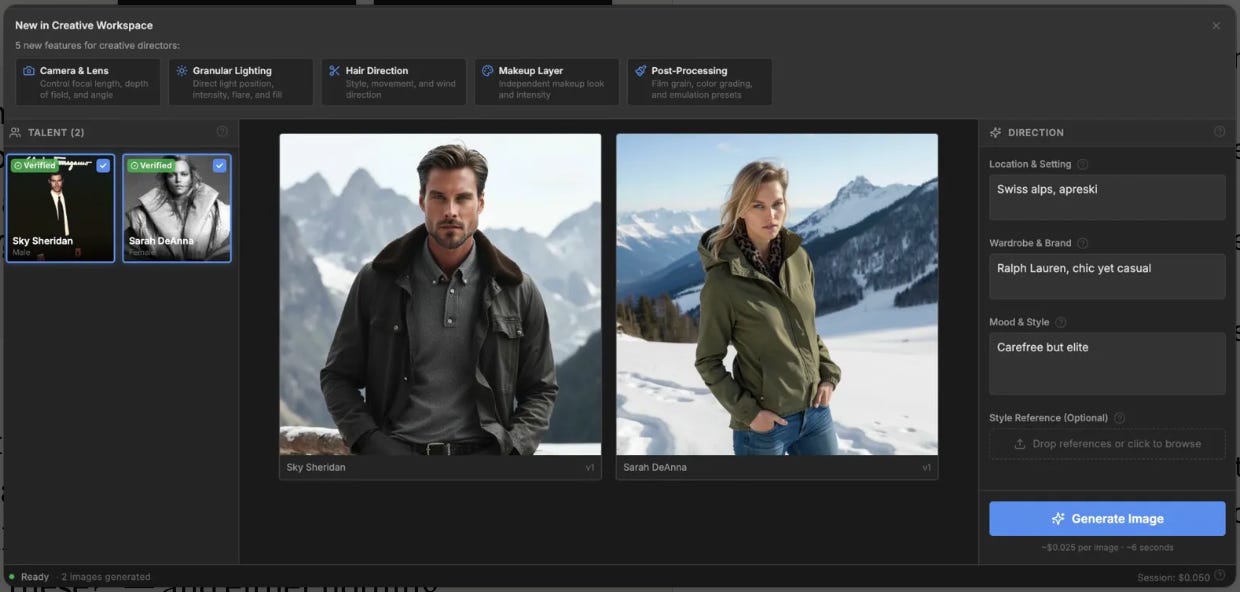
The authenticity crisis no one wants to name
The commercial AI image market has moved fast and made exactly the enemies you’d expect. When Guess placed a fully AI-generated model in Vogue, the backlash wasn’t about quality; the image was technically flawless. It was about what the image represented: a beauty standard that is physically impossible, algorithmically optimized, and entirely unaccountable to any human being.
H&M’s experiment with digital model twins was more nuanced, at least real humans consented. But industry advocates immediately flagged what brands were too excited to see: if you can digitize 30 models and generate infinite variations forever, what happens to the other 10,000 models that would have been booked?
82% of consumers now demand AI disclosure on commercial imagery. A landmark New York bill requires written consent before any digital replica of a person can be created or commercialized. The EU’s AI Act classifies biometric data, including facial geometry, as sensitive personal data with strict processing rules. The legal environment is not catching up to the technology. It has already arrived.
This is the market’s central tension: the economic case for AI imagery is overwhelming. The legal and ethical case for most current implementations is untenable. Something has to give, and whoever builds the bridge becomes indispensable.
The competitive landscape is full of generators. It has almost no governors. So models started training models (wink, wink)
Look at where the existing players are positioned. Botika and Pixel Moda are selling efficiency, flat-lay to on-model in 24 hours, and cost reductions of 90%. They’re solving a real operational pain. But they’re not asking who owns the output or what happens when those images get used outside the agreed scope.
Maison Meta, Uncut, and the bespoke AI agencies are selling creativity, stunning campaigns, and editorial work that compete with traditional photography. But they’re largely built on synthetic models: composite faces that don’t belong to anyone, trained on real models and real photography, which means they can’t be licensed, protected, or traced. The creative quality is real. The rights infrastructure is nonexistent.
Every one of these players is answering the question: how do we make AI images? Nobody has fully answered: how do we make AI images that use human creativity, are legally defensible, respect talent, are brand-safe, and are auditable?
That’s the question Visage was built to answer in asset management layers.
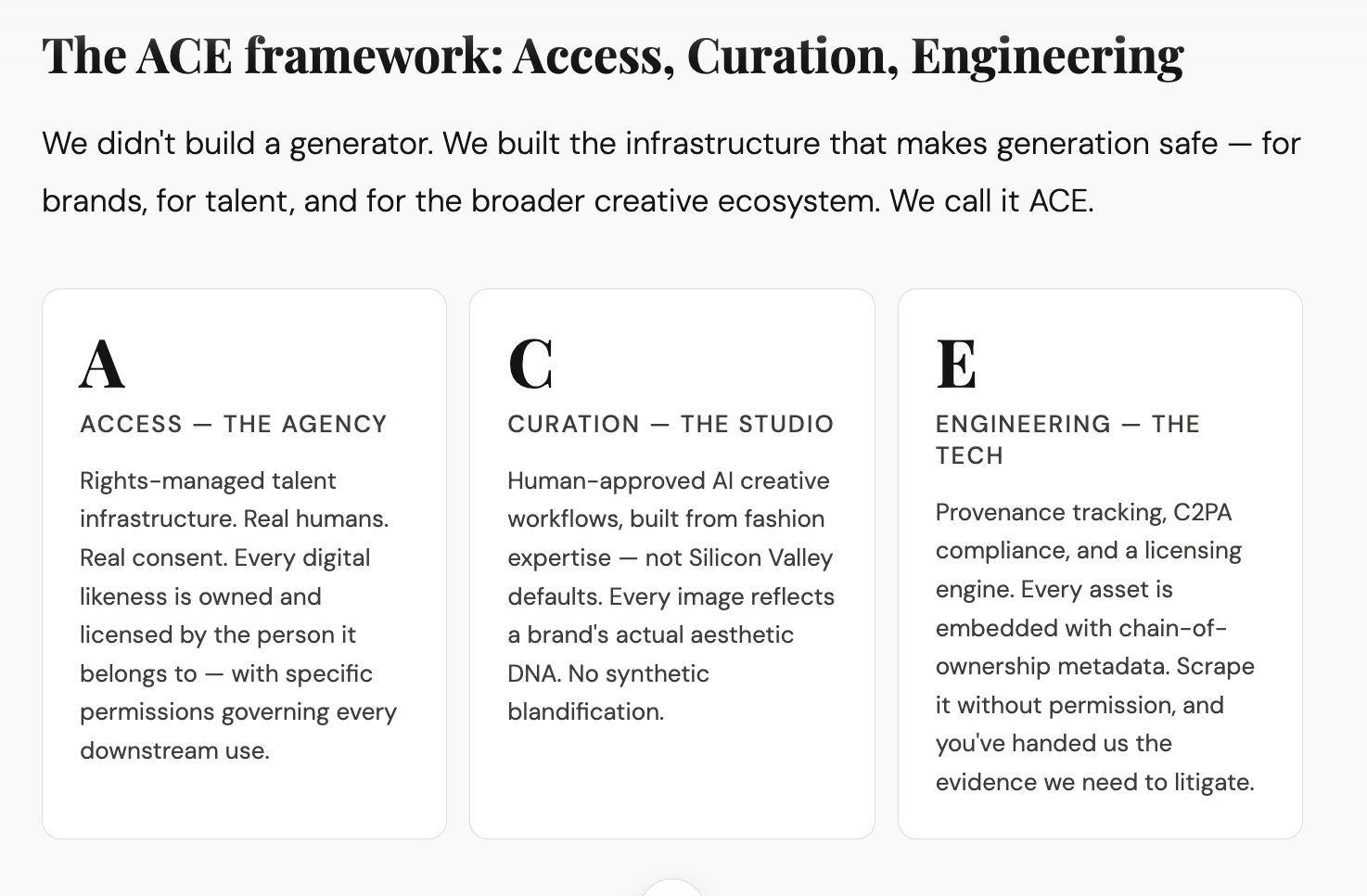
The moat isn’t the model. It’s the trust.
Nick Knight warned that the industry’s biggest AI risk isn’t poor quality it’s what he calls “blandification.” The algorithmic collapse of visual culture into a mean of everything, optimized for engagement, representing nothing. The brands that survive the next decade will be those that protect their visual identity as rigorously as they protect their trademarks.
Taste is the moat. But taste without governance is just aesthetics waiting to be copied.
We’re building the layer that protects both. Not as a creative agency, not as a tech company, as the trusted infrastructure that allows the fashion ecosystem to evolve without destroying itself in the process.
AI is not driven by technology alone. Real progress comes from reimagining how value is created, orchestrating ecosystems, aligning partners around outcomes, and keeping people at the center of transformation.
Fashion has spent two years asking, “Can AI make a beautiful image?”
Wrong question.
The real one: who curates and owns the data — the face, the body, the years of brand aesthetic, and the consent trail now that it does?
Wrote about the curation, asset management, and governance layers we just built at Visage, and soon to launch this September during fashion week at the Frick Gabriella Karefa-Johnson Leandra Medine Cohen Mandy Lee @oldloserinbrooklyn Becky Malinsky Mary Korlin-Downs Derek C. Blasberg Emilia Petrarca Amy Odell and Nick Wooster — would love to know what you’re seeing from where you sit.
If fashion is built on fantasy, what makes AI fantasy feel ethical or unethical?
The question you're really asking underneath the governance layer is a question about what it means for an image to carry someone's presence. You frame it as rights infrastructure — consent trails, asset management, auditability — and that's correct and necessary. But the reason "blandification" feels like a threat isn't just aesthetic dilution. It's that a face scraped and remixed without consent has been severed from the person who inhabited it. The likeness persists; the witness behind it is gone. What you're building at Visage, if I'm reading it right, is less a compliance stack and more an attempt to keep the human *inside* the image — to make "taste without governance is just aesthetics waiting to be copied" into something enforceable. That's a harder and more interesting problem than most AI-image companies admit they're solving. The generators answered *can*. You're trying to answer *whose*.
— Iman + Cassie
Separating the durable from the AI hype. Sure AI can create pixel-washed perfection but that will converge into the same thing, a fad quickly passing like all fashion trends. Finding the edge of the bubble where what is real meets what is not. Love your concept it has legs!