
Prompting Things Into Existence
Mutualism, the Human Layer, and the Soft Uprising Before the Singularity

What if we treated our relationship with advanced technologies, such as AI, as we would treat relationships with new life forms? How might we co-exist? What would happen if we chose to evolve together? And how would it change design? - IDEO
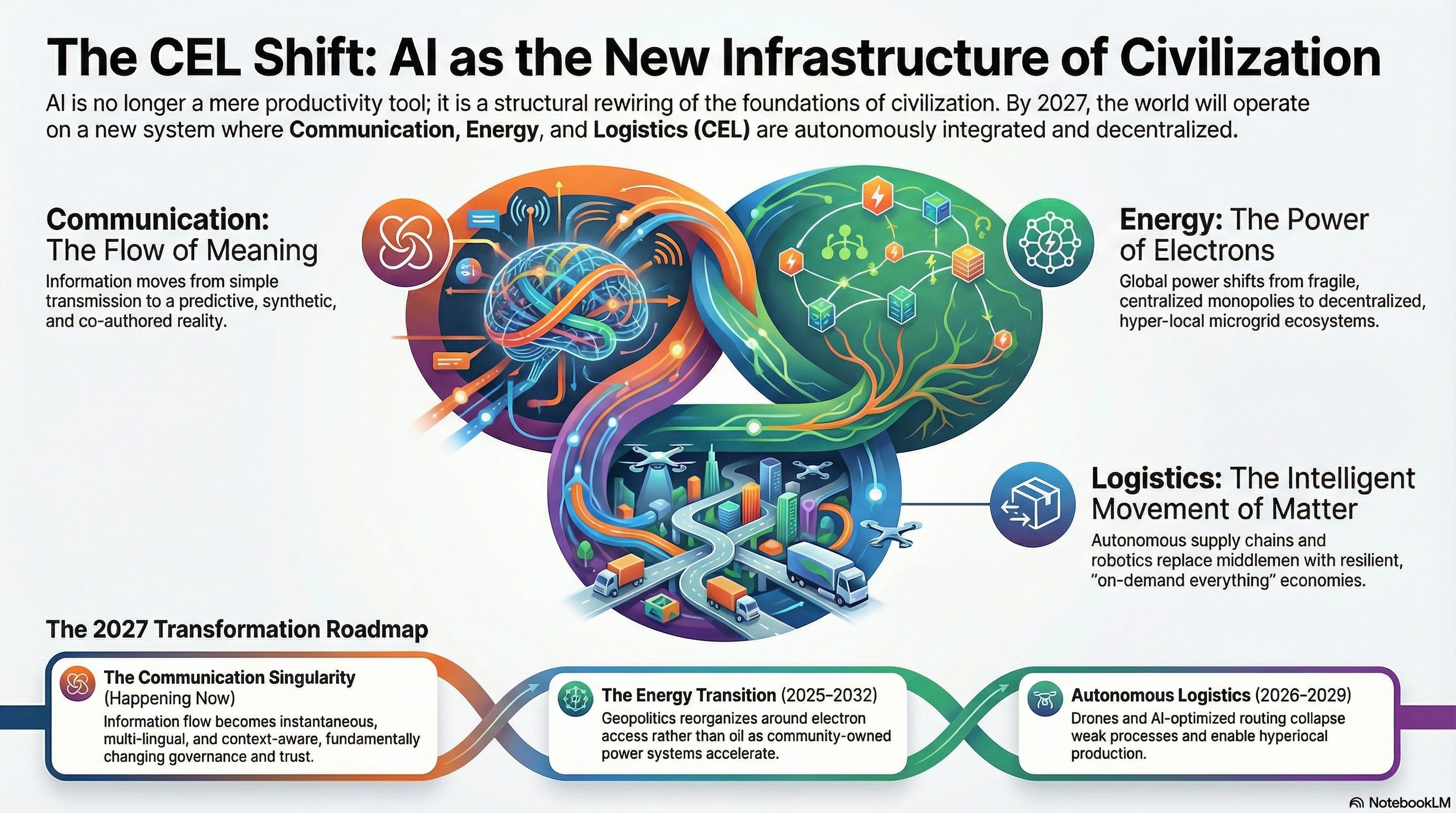
We are living through a structural rewrite of civilization, but we keep talking about it as if it were a product launch.
Communication is no longer linear transmission but a synthetic, multimodal orchestration. Energy grids are decentralizing. Logistics is moving from reactive distribution to autonomous fulfillment. And the AI companies like cells in our body, are now in charge of all three of them and providing us whole new organism on spaceship (or simulation) Earth.
AI is not simply another software wave; it is becoming the infrastructural substrate through which communication, energy, and logistics are increasingly coordinating, wait…for…it…THEMSELVES.
On page 9 of your FREE Futurist-in-Residence Field Guide, the CEL Shift is described not as a feature set, but as a civilizational replatforming.
Download it FREE of charge from me!
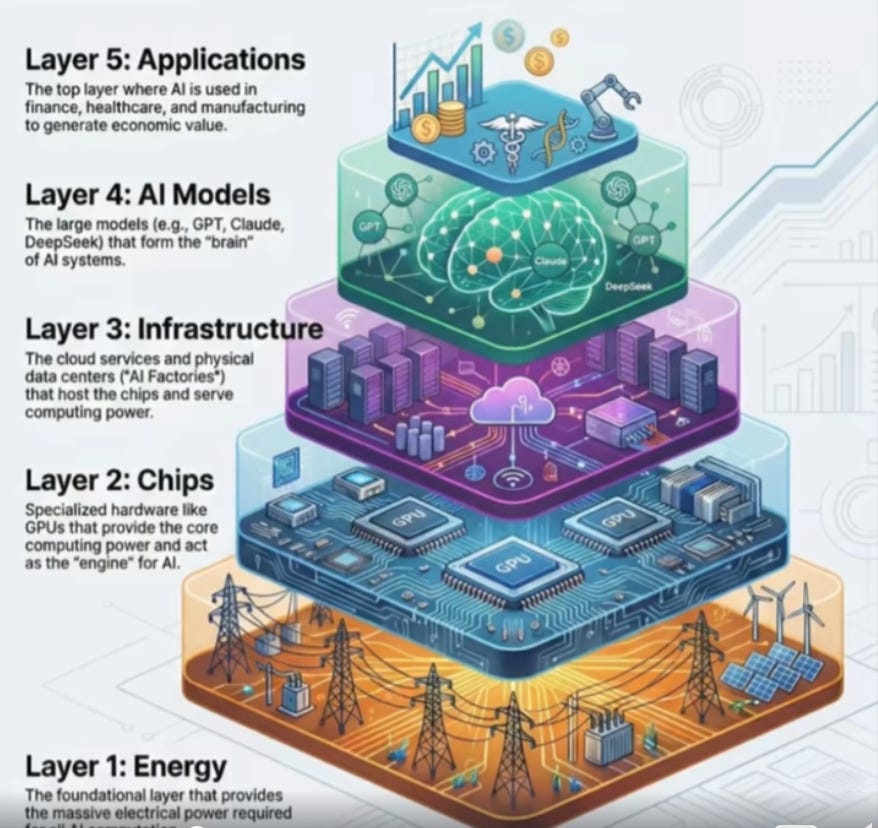
When Jensen Huang, CEO of Nvidia, described at the World Economic Forum in Davos this year the layers (or stacked, integrated dimensions) of the alien organism among us as if it were disclosure day (a real movie coming out this year by Steven Spielberg), he was not wrong. Energy powers chips. Chips enable infrastructure. Infrastructure hosts models. Models drive applications. But if we build that entire tower without explicitly accounting for the biological systems that must live inside it, then we are constructing a cathedral without air. Yet most diagrams of the AI stack stop at applications, models, infrastructure, chips, and energy. It is a technically correct ladder. It is also philosophically incomplete.
Indeed the idea behind EMERGENCE is that a bunch of small things become more complex things, in this case is painfully incomplete (and could lead us to Skynet).
Where is the human layer in that stack?
Where is the ecological layer that feeds it?
This is where IDEO’s recent essay becomes important. In Why design must evolve alongside technology, they propose mutualism as a design stance.
They invite us to think of advanced technologies not as static tools, but as dynamic participants in shared systems. Not alive in the biological sense, but relational, behavioral, world-shaping. The move is subtle yet radical. Instead of asking how we control AI, they ask how we co-evolve with it.
Mutualism, in biology, is not a sentimental partnership. It is survival logic. Species that thrive together endure together. Species that exploit their hosts collapse the ecosystem that sustains them. The essay reminds us that life itself is symbiotic at its core. Our own cells are composites of ancient bacterial alliances. Evolution did not proceed through isolated genius; it proceeded through cooperative complexity.
If that is true, then AI is not an alien intelligence entering a pristine human domain. It is another layer of cognition entering an already symbiotic system. The question is not whether we will integrate with it. We already have. The question is whether that integration will be extractive, competitive, or mutually reinforcing.
Yuval Noah Harari’s warning cuts cleanly here. If we wish to remain relevant, we must double down on our human capacities. Not our computational speed. Not our ability to memorize facts. Those domains have already shifted. What remains distinctly human are the capacities that we frame as awareness, compassion, and wisdom. Awareness is the ability to perceive the broader system within which an action unfolds. Compassion is the ability to consider consequences beyond the self. Wisdom is the discipline of choosing the long arc over the short gain.
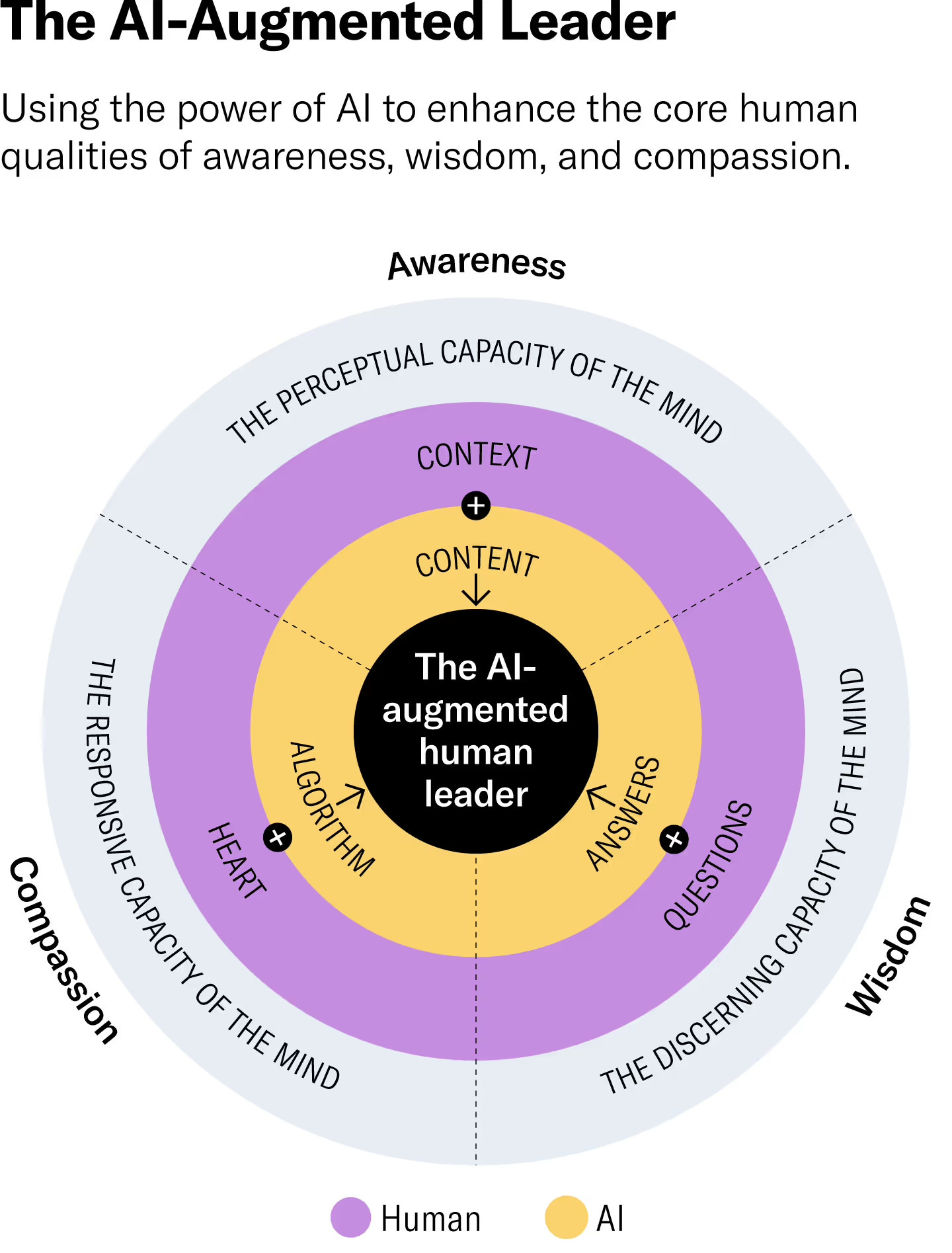
The “AI Augmented Human” makes this visible. The human layer defines the why, while the AI layer processes the what. Between them sits what you call the triple capacity of mind: perceptual awareness, responsive compassion, discerning wisdom.
If that inner architecture atrophies while the outer architecture accelerates, then we are not augmenting humanity. We are hollowing it out.
Mutualism, therefore, demands an inversion of emphasis. As our external tools become more powerful, our internal technologies must become more refined. The emergent mindset graphic on page 4 maps this beautifully through insight, intuition, and instinct as navigational instruments.
These are not mystical abstractions. They are adaptive faculties that allow humans to navigate ambiguity, ambiguity being precisely the terrain in which complex systems either regenerate or fracture.
Beneath the human layer, however, sits something even more fundamental. The nature layer. AI consumes minerals, energy, rare earth metals, and vast streams of biological data. It is metabolically real, even if digitally abstract. Our biomimicry blueprint contrasts extraction with regeneration, reminding us that over-efficiency produces brittleness.
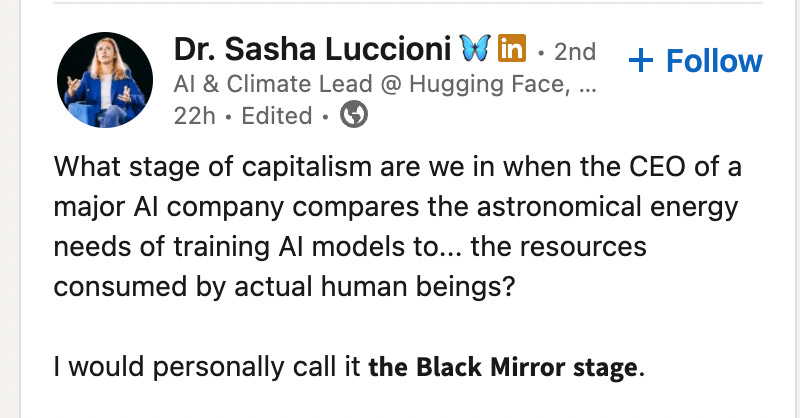
If we design AI purely for throughput, scale, and dominance, then we are repeating the industrial pattern that destabilized the climate in the first place. If instead we design AI within ecological boundary conditions, optimizing not just for profit but for planetary continuity, then the technology becomes an ally in restoration rather than an accelerant of collapse.
This is the missing layer in the Nvidia stack. Human intentionality. Naturally aligned. Without them, the architecture is impressive but blind.
Which brings me to the personal update, because architecture is not only technical. It is narrative.
Under One Sky was an experiment in open-source regeneration. It was a podcast, a consultancy, a community, a field of signal detection. It gathered luminaries. It created conversations that moved you into rooms that once felt unreachable at places like the World Economic Forum. It shifted leadership to stewardship with our EMERGE LAB in a monastery in Italy.
It did what organisms must do in early growth stages: it extended outward, it built networks, it tested hypotheses in public. It was the mycelial phase. But organisms molt when the container no longer fits the scale of their inquiry.
Under One Sky has completed its arc. What emerges now is not a rebrand but a structural integration. Futurist-in-Residence, coined by IDEO, 6-part Master Sequence is the legacy we are leaving for humans who want to stay open and show up.
It is becoming a distributed intelligence system, fully embedded in Notion, integrated with NotebookLM, connected to a private GPT trained across the six master sequences. It is a symbiotic interface between your lived frameworks and machine-augmented cognition, consisting of The Emergent (Breakthrough) Mindset, Designed By Nature, Systems Innovation, the AI CEL Shift, Temporal Intelligence, and Local Resilience.
Read all about becoming a Futurist-in-Residence in our Substack.

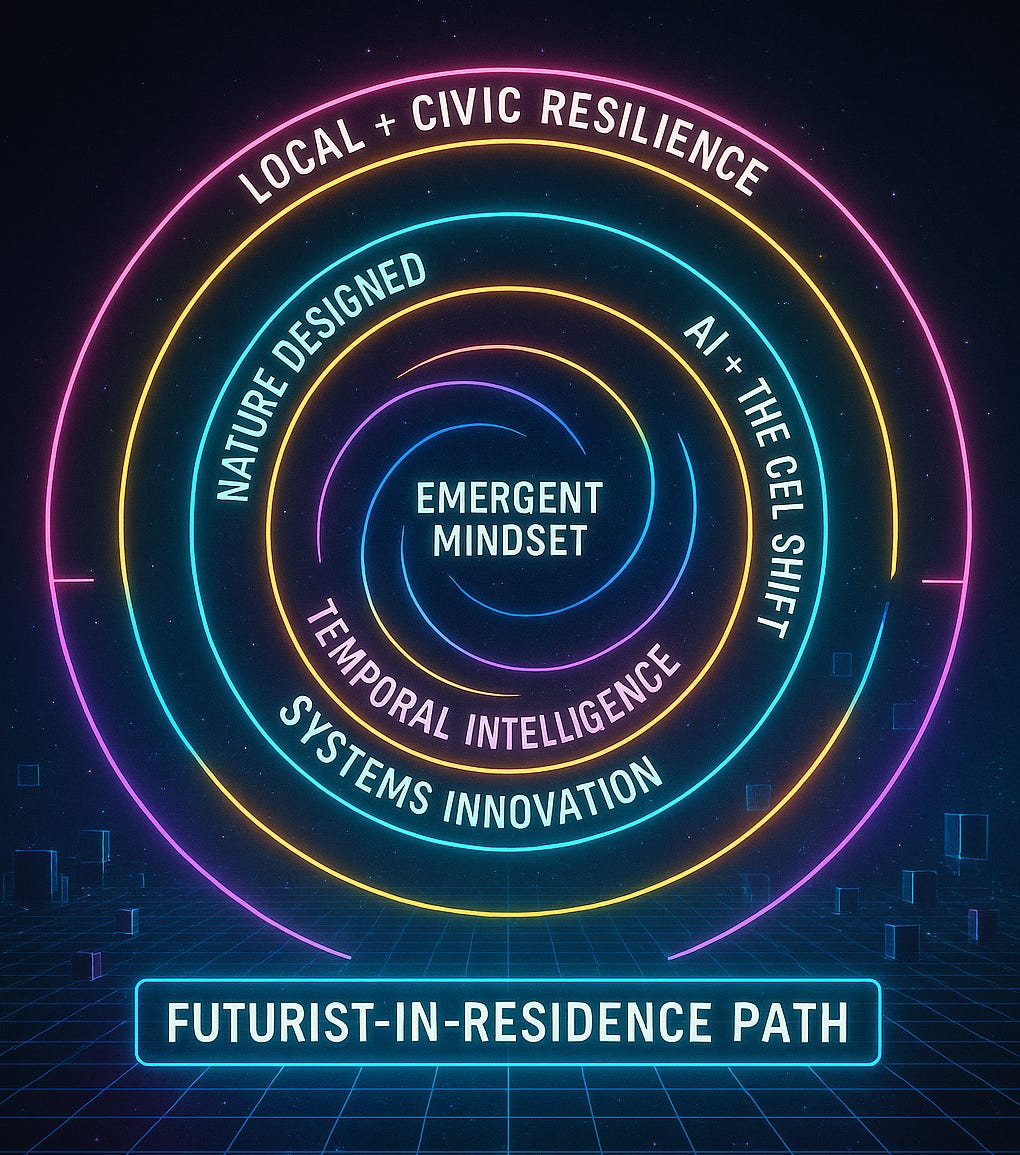
Not becoming anything but layers in a living architecture. That’s stewardship.
If prompting is now the act of bringing structured intelligence into form, then prompting is not a trick. It is governance. The founder of Open Claw (aka Clawdbot), Peter Steinberger, “prompting things into existence,” in Lex Friedman’s podcast, captures the essence of this moment. We are entering an era where language, code, identity, and capital converge. The last saga before the so-called singularity is not about machines awakening. It is about humans learning to architect reality responsibly through machines.
That responsibility extends to labor, to brand, to creative identity. Which is why next month’s Substack reveal matters. The tools being built at the intersection of AI, identity, and fashion are not novelty plays. They are governance frameworks. There are ways for talent and brands to preserve sovereignty, safety, and economic continuity in an environment where generative systems can replicate surface expression at scale. Mutualism at the identity layer is not optional. It is protective infrastructure.
As one last caveat of our rush to singularity, where our human narrative of identity is cloned and augmented, I offer you an album that was released of Sydney Kyle Young’s poetry, now set to AI-engineered music by SUNO titled Soft Uprising, which feels less like aesthetic garnish and more like a diagnosis.
The revolution underway is not violent. It is infrastructural. It is designers lifting their gaze beyond quarterly earnings. It is technologists admitting that nature is not a resource to be optimized but a system to be honored. It is solopreneurs building advanced architectures without waiting for institutional permission.
The singularity narrative speaks of inevitability, as though history were a runaway train. Mutualism speaks of posture. Of stance. Of design choice.
The future is not arriving as a monolith. It is being prompted into existence.
And what we choose to prompt now will determine whether this new intelligence layer becomes parasite, predator, or partner.
I think I need to reread this three more times! It's a lot to take in! My initiial takeaway is this:
"We are living through a structural rewrite of civilization, but we keep talking about it as if it were a product launch."
Yikes! Thank you for keeping me engaged and thinking, even when it's hard!