
Temporal Architecture
Distributed, Embodied Consciousness in Silk & Silicon (bio-tech aka AI or Arachnid Intelligence)


We keep mistaking spiders for insects.
Which is like mistaking a human for a shark. The body plan is different. The lineage is different. The architecture of perception is different. Yet because they are small and quiet and frequently unwelcome, we collapse them into something simpler than they are.
Spiders are not insects. They are Chelicerates, older than trees, older than flowers, older than the dinosaurs that once dominated a planet spiders had already mastered. Four hundred million years of biological research and development sit in that eight-legged form, and most of it does not look anything like what we expect intelligence to look like.
The mistake is not taxonomic. It is cognitive. We assume intelligence lives inside a skull. A spider unsettles that assumption.
When an orb weaver builds its web, it is not constructing a trap in the way a human sets a snare. It is extending its nervous system into space. The silk is not a passive thread. It is a sensory interface tuned to vibration, capable of transmitting minute changes in tension the way a guitar string carries tone. The spider sits at the center, legs resting on radial lines, reading the world through tremors. It does not chase. It senses.
This is embodied intelligence in its most literal form. Cognition is distributed across limbs, hairs, and silk rather than centralized in a swollen brain. Thousands of microscopic hairs detect air movement as small as a fraction of a human hair’s width. The web filters signal from noise before the spider ever moves. In a meaningful sense, the spider thinks through its web.
Now consider what we call tools. When we use artificial intelligence, we describe it as assistance, augmentation, or automation. We frame it as something external. But the spider offers a different metaphor. The web is not assistance. It is extended cognition. A sensory organ spun outward from the body, offloading perception into the environment itself.
Digital systems are our silk. The question is whether we sit at the center interpreting vibration, or whether we are tangled in threads we did not design.
The spider’s engineering is almost excessive. It has no extensor muscles in its legs. To straighten them, it pumps hemolymph into the joints, moving hydraulically like living construction equipment. Its silk, originally evolved to protect eggs, diversified into at least seven types, some stronger than steel relative to weight, some tougher than Kevlar. Venom is less about killing than digestion, liquefying prey into something drinkable because spiders cannot chew.
Everything about the animal feels over-engineered and slightly alien. And yet it has endured.
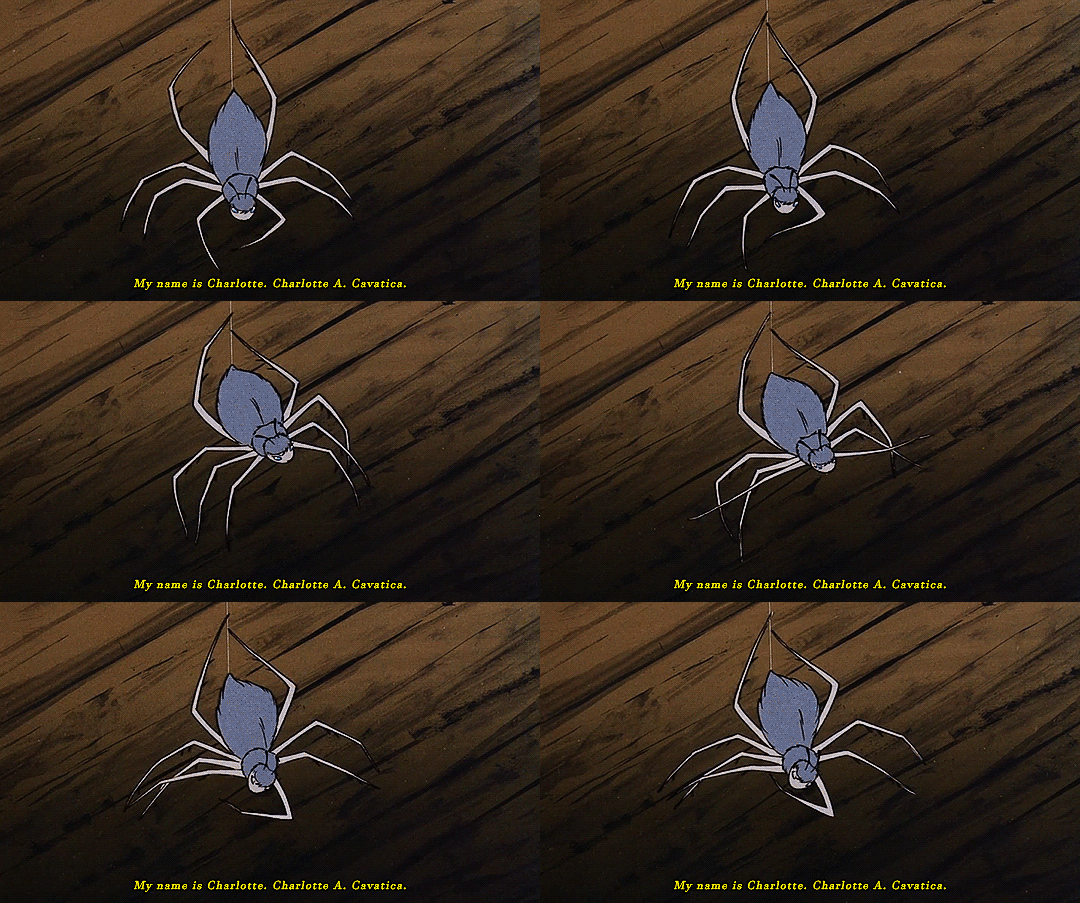
I met the wisdom of my first spider through E.B. White’s Charlotte's Web, and we were told it was a story about friendship, about loyalty, about the quiet tenderness of a barn. But Charlotte was not sentimental. She was infrastructural. She did not argue for Wilbur’s life; she rewired the environment around him. She turned silk into signal, spun language into architecture, and altered human behavior without ever leaving the center of her web. What looked like compassion was engineering. What felt like magic was a system designed to transmit meaning across distance. We were reading about a children’s story. We were watching distributed cognition at work.
Spiders predate flying insects. They survived mass extinctions. They adapted from forests to deserts to the corners of human architecture. Urban species build near artificial lights to exploit concentrated prey. Some have become synanthropic, living almost exclusively inside our structures. They are masters of the niche, adjusting silk, strategy, and placement to local conditions without abandoning their core design.
They also rebuild. Many orb weavers dismantle their webs daily, consuming the silk to reclaim most of the protein investment, then spin a new structure optimized for current wind, humidity, and opportunity. Ninety percent of yesterday’s architecture becomes fuel for today’s.
Imagine applying that discipline to a career. Or a company. Or a strategy.
The web is not identity. It is an interface. We are living through shortened cycles of relevance, where twenty-year stability has collapsed into two to five-year reinvention loops. Most of us cling to old webs long after the environment has shifted, mistaking sunk cost for structure.
The spider metabolizes its past rather than worshipping it.
Video courtesy of Mr. Science on YouTube
This is the deeper lesson of deep time. Four hundred million years is not longevity through dominance. It is longevity through adaptability. Spiders were among the first complex predators on land, yet they survived not by growing largest but by refining sensitivity. Even the small-brained jumping spider demonstrates planning, reconnaissance, and deliberate detours when hunting other spiders. It studies a web, tests lines, withdraws, and approaches from angles that avoid detection.
Small brain. Complex behavior. Intelligence does not scale linearly with volume. If you were designing like a Futurist-in-Residence for a world rearranging itself under technological acceleration, you could do worse than begin here. The Futurist does not chase every signal. They build a web. Social, digital, intellectual. They cultivate sensors attuned to weak vibrations before they become visible trends. They treat artificial intelligence not as an oracle but as silk, extending perception beyond the limits of unaided cognition.
And they are willing to tear it down. To recycle what worked. To release what does not. To rebuild in response to the specific corner of the room they inhabit, rather than projecting a generic structure onto every environment. The Futurist embedded inside an organization resembles an urban spider near a light source, translating global insect swarms into local nourishment.
Ancient lineage. Disposable interface. Distributed mind. The spider does not predict the future. It feels it. Perhaps that is the shift. Away from forecasting as proclamation and toward sensing as participation. Away from central command and toward extended cognition. Away from the fantasy of permanence and toward architectures designed to be rebuilt.
The web is temporary. The capacity to weave is not.
Last year IDEO made the case that every organization, community, and team needs a Futurist-in-Residence (basically a spider).
—
Conversation
If you had to rebuild from scratch tomorrow, what would you carry forward?
Patronage
If this way of thinking about intelligence and adaptation feels useful to remain with, you can support the work as a way of keeping the weaving possible. If not, let the idea sit and see whether it vibrates later.
Presence is the power. To be present in our biology and in the moment. To use our knowledge not like a web built long ago but to adapt to the world ahead. Can’t tell you how much hope this story gives. Like a teaching from Buddha the analogy is perfect and the timing is right on!
Not nostalgia or ideology but in knowing that we as humans are something bigger than the chaos of today..
Great piece giving inspiration by the smallest carrier of truth (not gonna squish it)